
Cartier En Équilibre: The Mathematics of Restraint
Cartier's new high jewelry collection operates on a deceptive premise—that balance is simple. It's not. Balance in jewelry means reconciling geology with geometry, finding stones that shouldn't work together and making them inseparable, hiding months of technical problem-solving behind pieces that read as effortless.
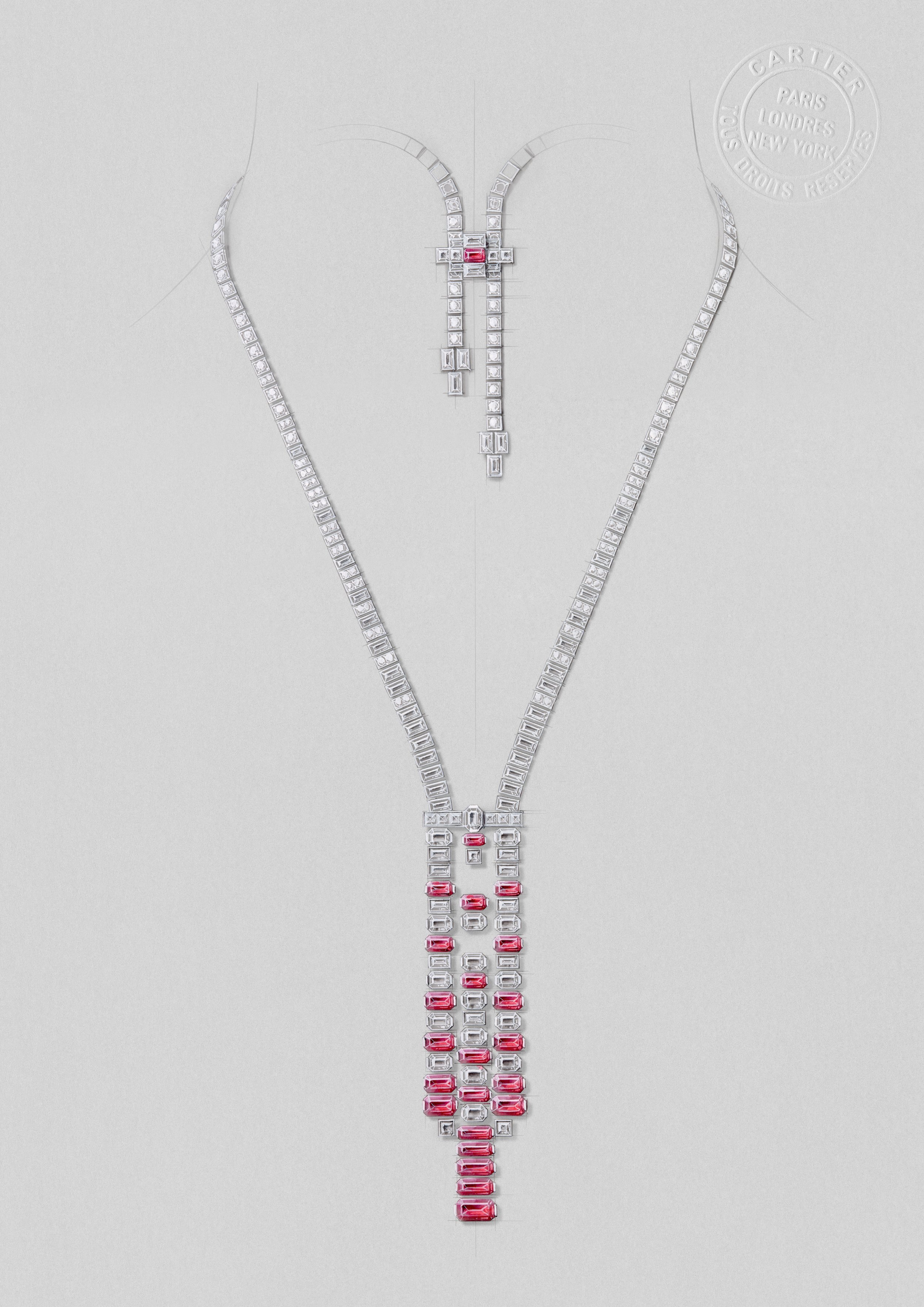
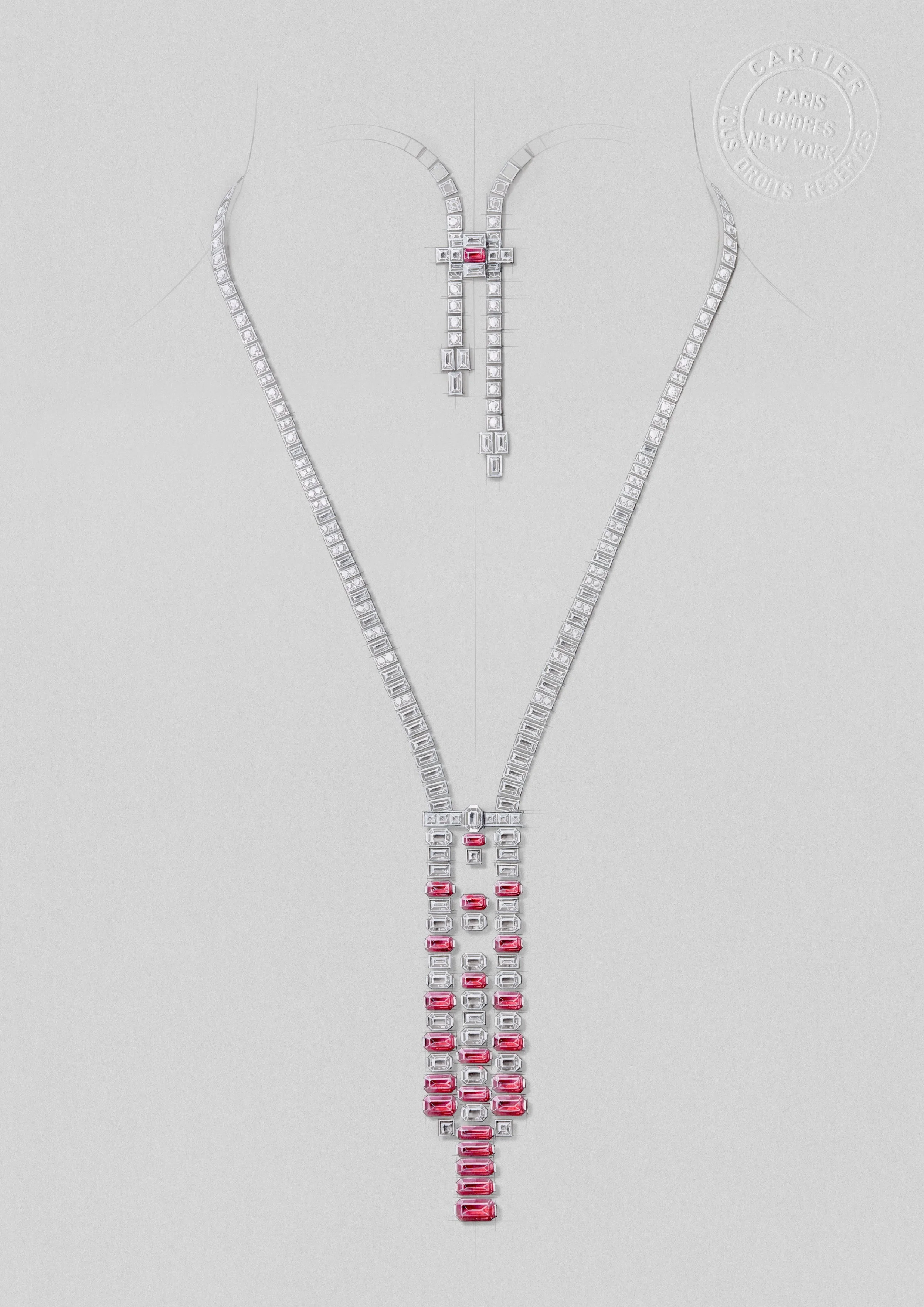
Euphonia opens with an unusual partnership: emerald-cut rubies matched with emerald-cut diamonds, both from single batches. That shared cut is the foundation. Finding rubies and diamonds that can sit together like this—same proportions, complementary rhythm—is rare. The design layers in square cuts, baguettes, and brilliant-cut diamonds for contrast, building an abstract, geometric composition. A sliding clasp on the back adjusts how the two strands drape, adding flexibility to the structure. Between the openwork shapes and alternating stones, the piece generates movement through pattern rather than curve.
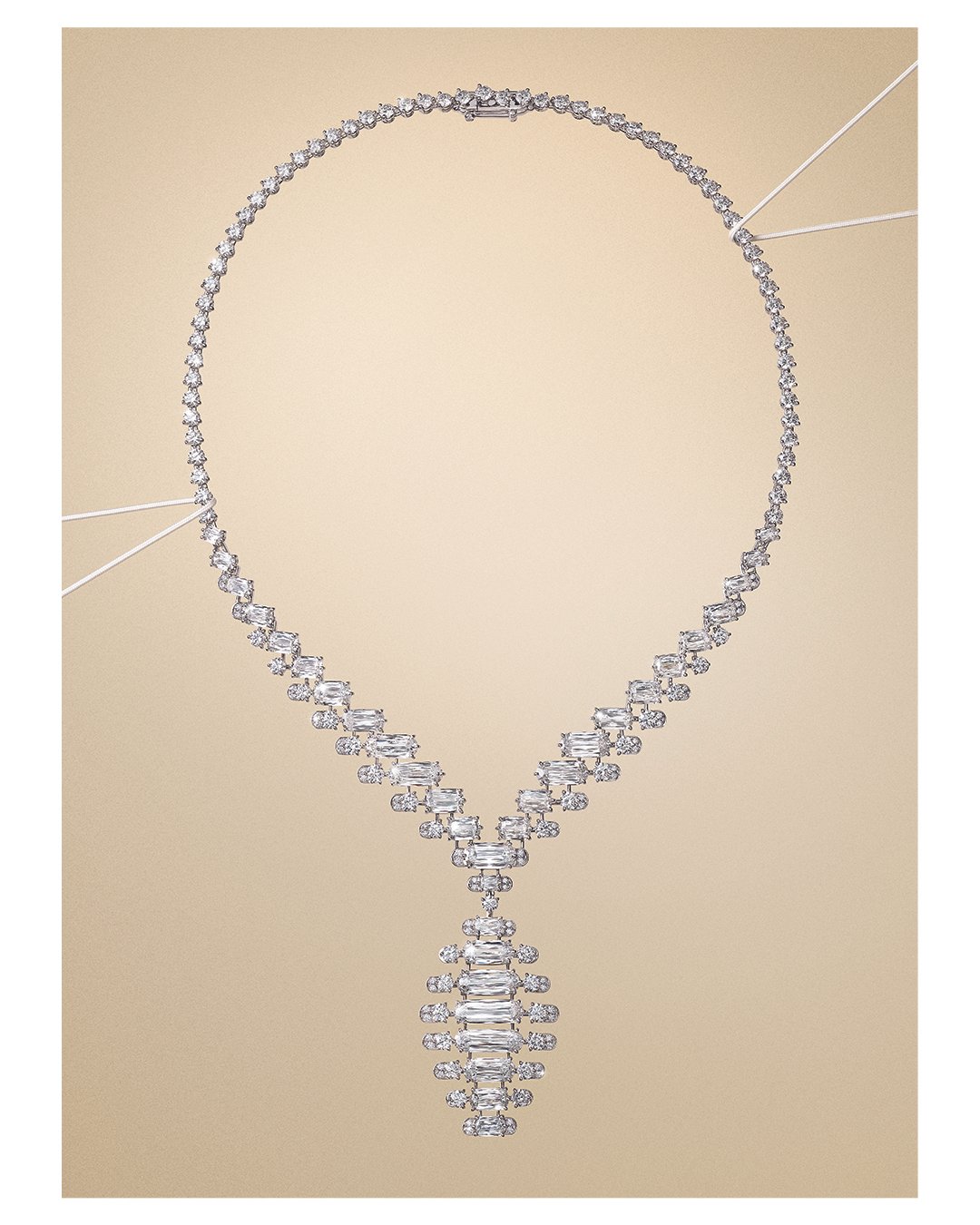
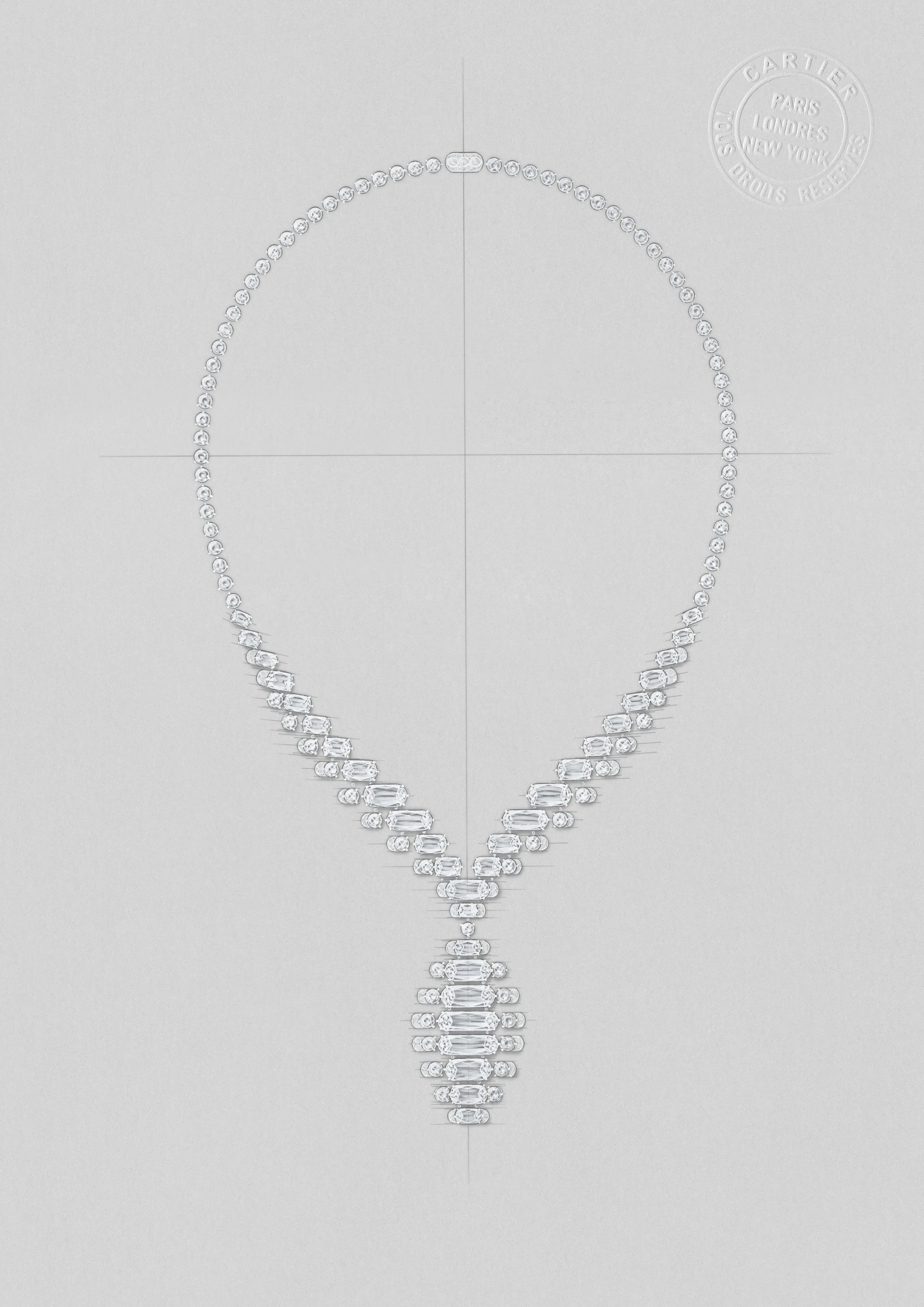
Splendea takes a different approach to the same principle. Thirty-four perfectly matched diamonds form a continuous ribbon, their settings nearly invisible. When you can't see the mechanics, the stones become the architecture. That "uninterrupted wave" effect comes from precise positioning—each diamond placed to carry visual momentum to the next. The craftsmanship succeeds when it disappears.
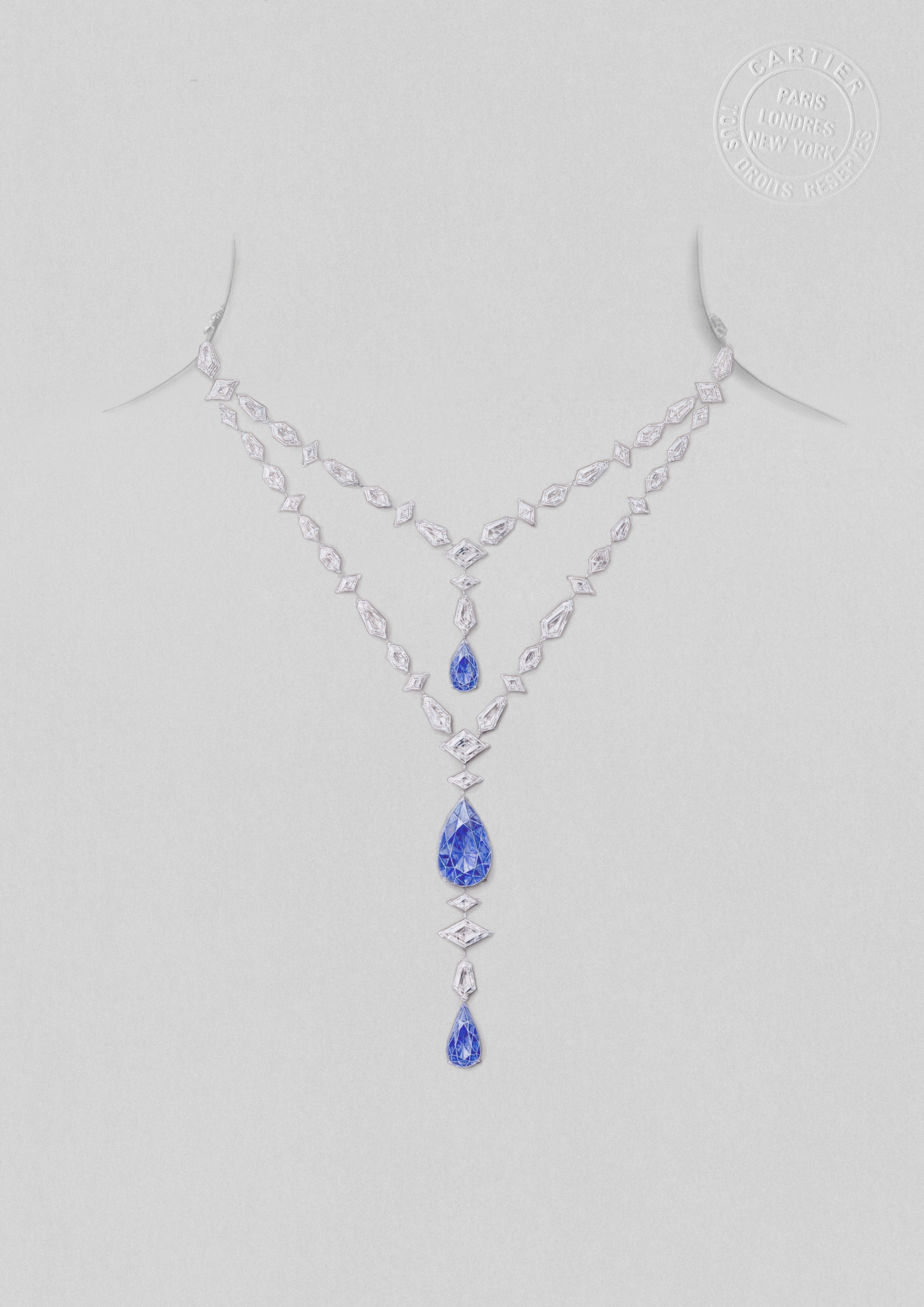
Parcae is the counterargument—deliberate restraint as design philosophy. Three pear-shaped Madagascar sapphires (16.59 carats total) line up along the central axis, creating the gravitational center. The surrounding diamonds use three cuts—kite, diamond, and brilliant—to build rhythm and structure around those blue drops. "Nothing in excess" doesn't mean minimal; it means every element has a specific function. The drape follows precise lines so those sapphires sit exactly where intended.
Ondora reaches back to Cartier's early 20th-century palette: chrysoprase, spinel, turquoise, diamond. The design balances organic forms against geometric cuts—smooth chrysoprase beads and cabochons set with square-cut and brilliant-cut diamonds, studded with spinels. Matching pendants front and back (the rear one adjustable) follow Cartier's transformable jewelry tradition. The jellyfish inspiration is abstracted into fluid structure, those chrysoprase beads mimicking underwater movement translated into wearable form.
The collection's tension lives in two quotes. Jacqueline Karachi, Director of High Jewellery Creation, describes "sophisticated simplicity" and "the art of looking at things differently." Alexa Abitbol, Director of the High Jewellery Workshops, focuses on "technical transcription of the original aesthetic intention" and "precision and mastery." One designs the paradox, the other solves it in metal and stone.
That gap between concept and execution—between Karachi's vision and Abitbol's craft—is where these pieces actually exist. Balance isn't the starting point; it's what you achieve after reconciling opposing forces. Geometry with organic flow. Visibility with concealment. Exceptional stones with invisible settings. The harmony Cartier's after isn't natural. It's engineered, then polished until the engineering disappears.